
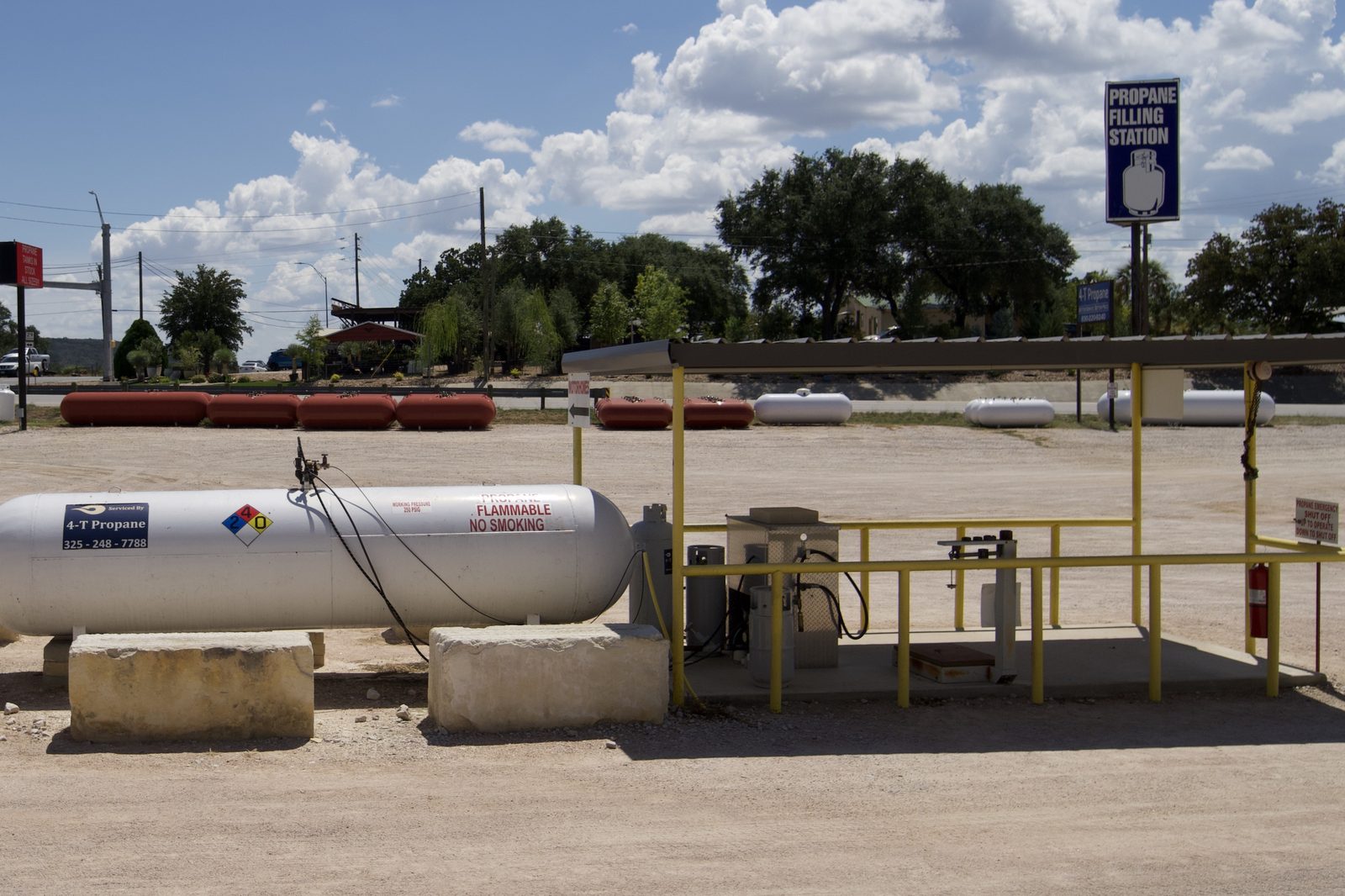
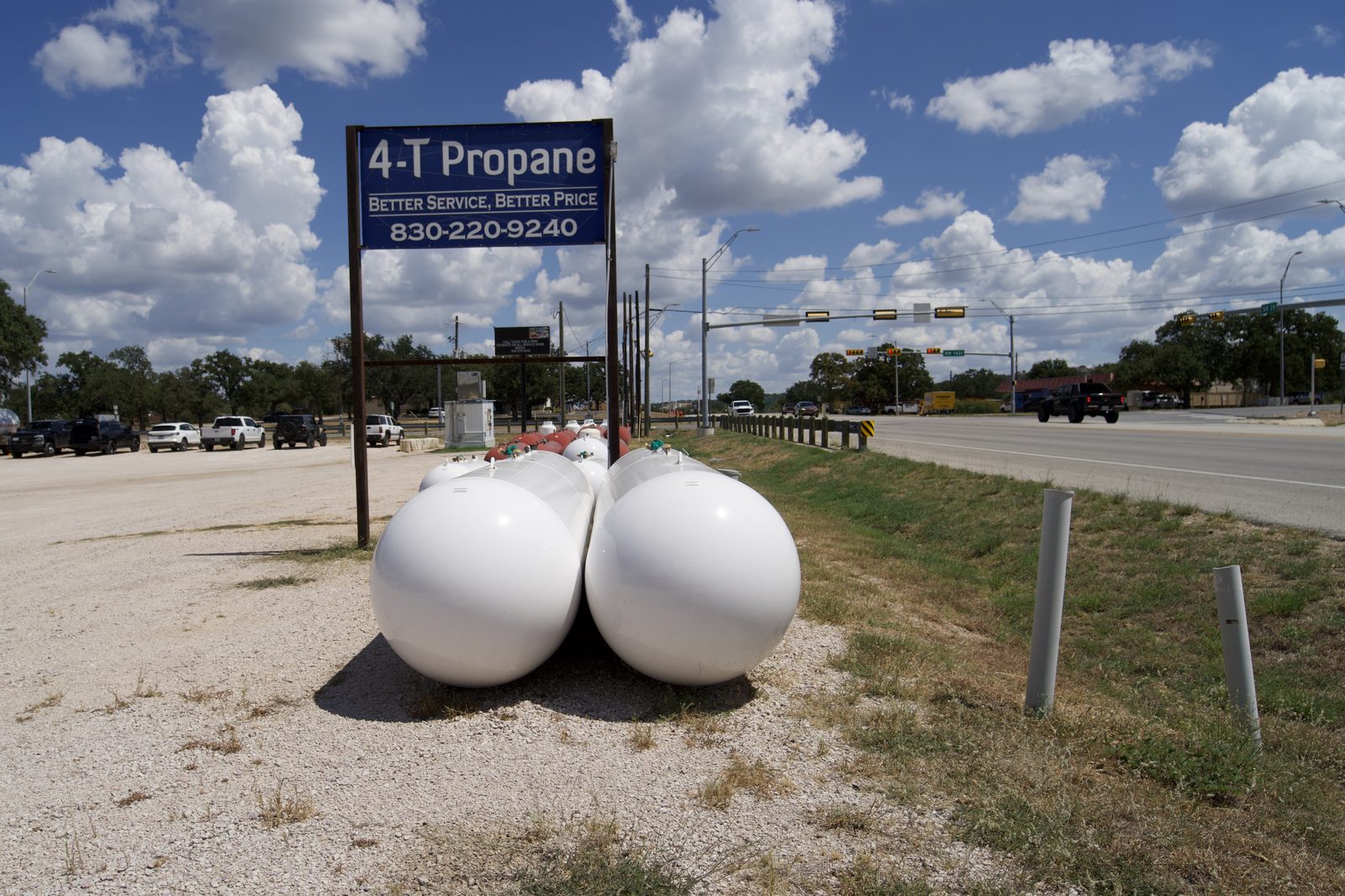
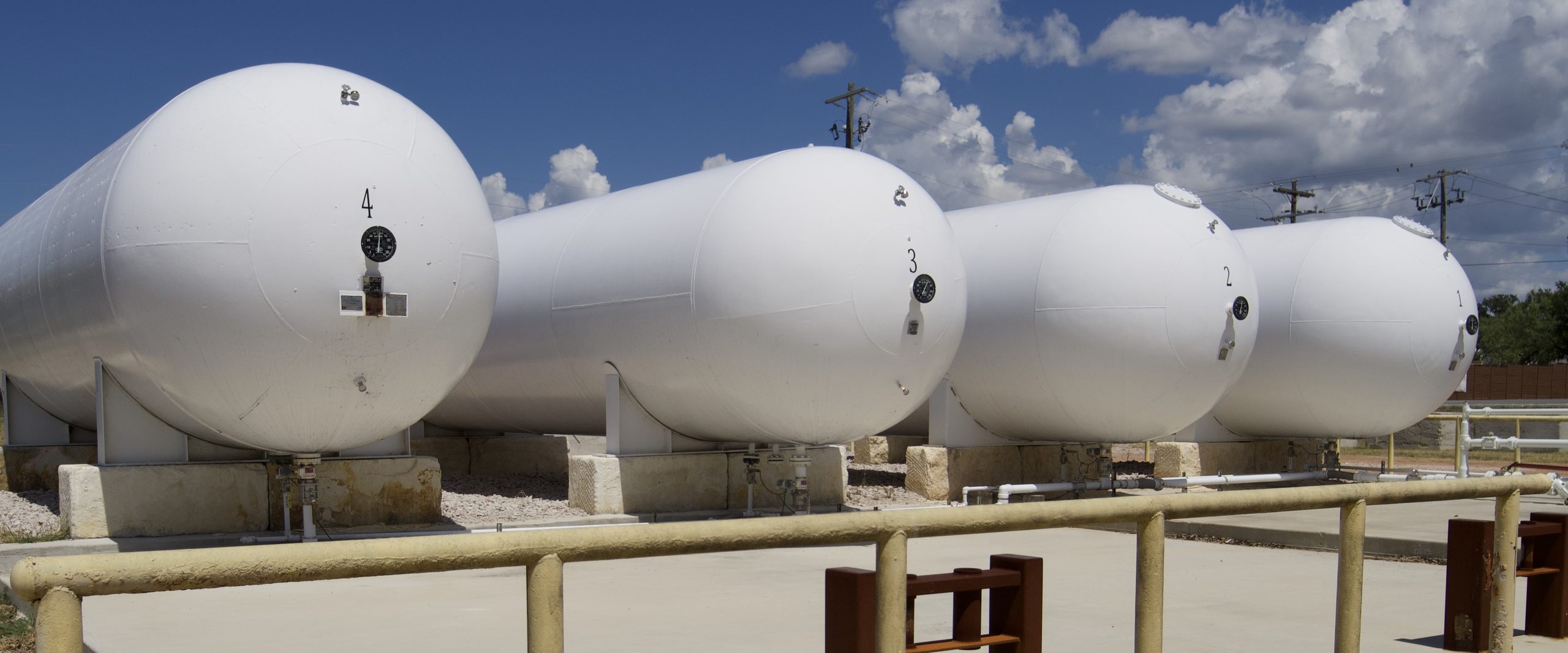
A propane tank is a pressure vessel that holds your fuel as a liquid, sized to what your home burns and placed to meet the safety code. Most Hill Country homes run a 250, 500 or 1000 gallon horizontal tank, leased from us or owned outright, set either above ground or buried.
Those four decisions, size, ownership, placement and type, are what this guide covers. Get them right at the start and the tank is something you stop thinking about. Get them wrong and you are living with it for twenty years. 4-T Propane sets tanks across the Highland Lakes and Northwest Austin out of three locations.
- What a propane tank actually is
- What size you need
- Leasing or owning
- Where it can go
- Above ground or buried
- What happens when we set it
- Tanks against cylinders
- Inspection and recertification
- Looking after it
- Frequently asked questions
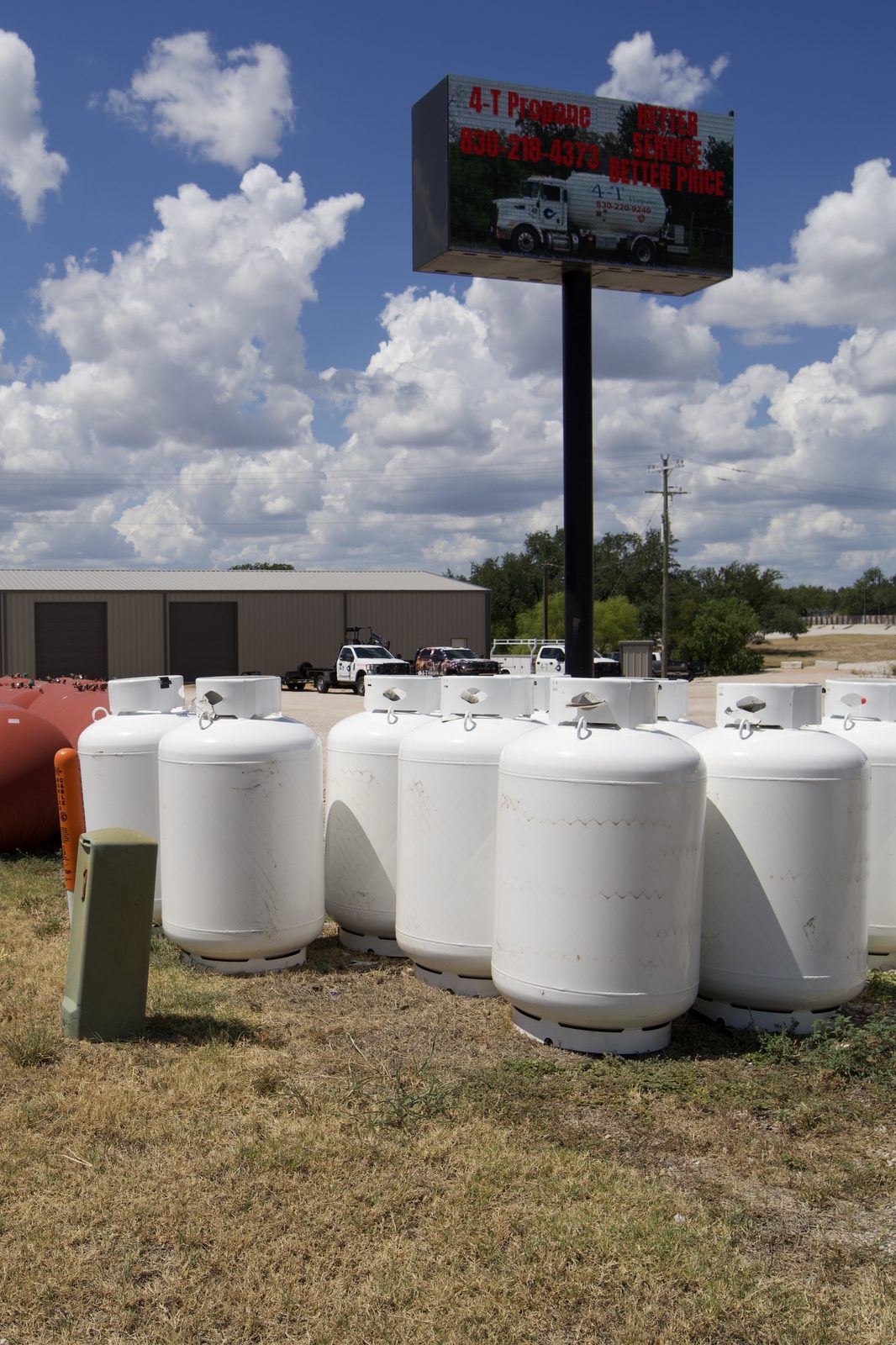
What a propane tank actually is
A steel pressure vessel holding propane as a liquid. Pressure is what keeps it liquid, and releasing that pressure at the valve is what turns it back into the gas your appliances burn.
Why it is never filled to the top
Liquid propane expands as it warms, so space is left above it for a hot afternoon. A full tank reads about 80 percent on the dial, which surprises nearly everybody the first time. Reading that dial is covered in our guide to the tank gauge.
The parts you can see
Under the dome lid are the fill valve, where our hose connects, the service valve that feeds your house, the relief valve, and the float gauge. The regulator steps the pressure down to what your appliances expect. The only one of those you ever need to touch is the lid.
Why so many homes out here run on it
Once you are past the gas lines, propane is how a house gets heat, hot water and a cooktop that works. That covers most of the Highland Lakes and a good deal of the country out toward Liberty Hill and Andice.
What size you need
Size is decided by what you burn, not by the size of the house. A big home using propane only for cooking needs less tank than a small one heating with it through a Hill Country winter.
The common residential sizes
| Tank | Typically suits | Notes |
|---|---|---|
| 120 gallon | One or two appliances, often hot water or a cooktop | Usually stands upright. Too small for whole home heat |
| 250 gallon | A couple of appliances, light heating use | A common step up on a weekend place |
| 500 gallon | Whole home heat plus hot water and cooking | The most common residential tank we set |
| 1000 gallon | Large home, high use, or a long gap between fills | Also common where access is difficult |
Bigger is usually the safer mistake
An oversized tank costs you nothing in fuel, because you pay for gallons not capacity. An undersized one means more deliveries and a shorter runway in a cold snap.
Where it is a close call we lean bigger, especially at the far end of a ranch road. The full working is in what size propane tank do you need.
What actually drives the number
Four things decide it: whether propane heats the house, whether it also does hot water, cooking and a fireplace, how cold your spot gets, and how far you are from one of our locations.
Distance surprises people. A property at the end of a long caliche road is better off with a bigger tank and fewer visits.
Pool heaters and shop heaters change everything
A pool heater can burn more in a weekend than a kitchen does in a month, and a heated workshop is the same story. If either is on your list, say so before we size anything, because it moves the answer by a whole tank size.
Leasing or owning
A leased tank belongs to us and we look after it. An owned tank belongs to you, along with the maintenance and the responsibility.
What a lease covers
The tank itself, and keeping it serviceable. If a leased tank needs work or replacing, that is ours to deal with. Most of the tanks we set are leased, because it keeps the thing simple for the homeowner.
That covers the 250, 500 and 1000 gallon tanks that make up almost every residential install we do, and it covers them for the whole life of the vessel, which on a well maintained steel tank runs to decades.
What owning changes
You can buy propane from anyone, which is the real argument for owning. Against that, the tank is an asset you have to maintain, recertify and eventually replace. It is a genuine trade off rather than an obvious answer, and we have set it out properly in should you lease or buy your propane tank.
Check who owns the one already there
If you have just bought a place with a tank on it, find out whose it is before you need fuel. Only the owner of a tank can authorize filling it.
Sorting that out during a freeze is nobody’s idea of a good week. Call us and we will help you work out what you have.
Where it can go
Not wherever you would like. Tank placement is governed by the national propane code and enforced locally, and the required clearances change with the size of the tank.
What the rules are protecting
Distance from the house, from openings like windows and doors, from ignition sources, and from the property line. The standard is NFPA 58, and it is the same code that governs how we fill the tank.
We will not guess the distances for you
The required distances depend on tank size and on the particular property, which is why we come and look rather than quote a number over the phone. The site assessment is free, and what the visit covers is in where can a propane tank go on your property.
Access matters as much as the rules
A tank in a spot the truck cannot reach with a hose is a problem every single delivery, for as long as you own the house. Think about the bobtail before you think about the view, and ask us what the truck needs before you pour a slab.
Above ground or buried
Above ground is cheaper to install and simpler to service. Buried disappears from the garden and costs more to put in.
The case for above ground
Lower install cost, easier inspection, and straightforward to move or replace. It is what most homes around here have, and there is nothing second rate about it.
The case for burying it
A buried tank is out of sight, which on a lake property with a view is often the whole argument. Burying one needs the right ground conditions and corrosion protection, so it is a bigger job and a bigger decision.
Decide before the house is finished
Burying a tank is far easier while there is already machinery on site. If you are building out toward Liberty Hill or Leander, raise it early rather than after the landscaping is in.
What happens when we set it
A crane truck brings the tank, places it on its base, and a gas line is run to the house. Then the system is pressure tested before any gas flows.
The site has to be ready
The location has to be agreed and reachable, and the base has to be right for the tank. That is what the earlier site visit settles.
Nothing gets gas until it passes a test
The line between tank and house is pressure tested, and appliances are checked and lit by someone qualified. The whole day is walked through in what happens on tank set day.
Tanks against cylinders
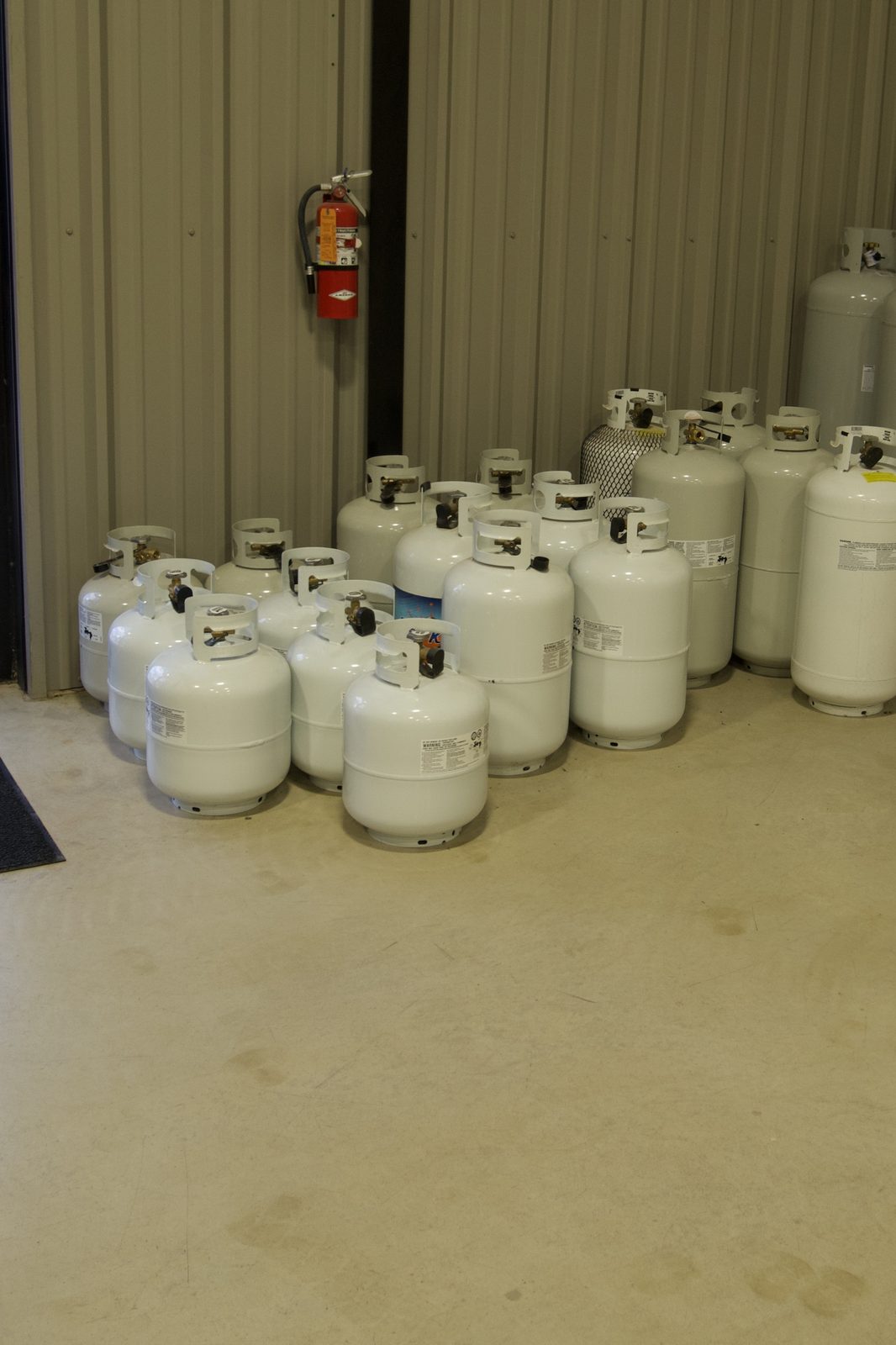
A tank is filled where it stands. A cylinder is the portable bottle you carry to us, for a grill, an RV, a patio heater or a forklift.
Refilling beats exchanging
A refill fills your bottle to its proper capacity and you keep your own cylinder. An exchange cage hands you somebody else’s bottle, usually with less gas in it. The comparison is in propane cylinder refill or exchange.
Cylinders have an expiry date
A cylinder has to be recertified a set number of years after manufacture before it can legally be refilled. We recertify at our locations, and we will tell you if yours is out of date rather than quietly turning you away. Bring it in and we will check the date on it.
Looking after it
A propane tank asks very little of you. Four things are worth doing.
Beyond delivery we set and lease tanks, recertify cylinders, run safety inspections, gas checks and pressure tests, fit tank monitors, and install, repair and convert propane appliances. Your account and your bill are online, on the web or the phone app.
- Keep the area around it clear of brush, stored items and parked vehicles.
- Do not paint it a dark color. Tanks are light colored so they reflect heat.
- Keep the lid closed when you are not reading the gauge.
- Tell us if you see rust, damage, or anything that was not there last year.
What not to do
Do not build a deck over it, fence it in so tight a hose will not reach, plant a hedge around it, or stack firewood against it. All four happen, and all four turn into a problem on a delivery day.
If you smell gas
Propane has an odorant added that smells like rotten eggs or a skunk. If you catch it, get everyone out, leave the doors open, do not touch switches, and call us from outside.
Inspection and recertification
Propane equipment is inspected on a schedule, and portable cylinders carry a hard expiry. A stationary tank and a barbecue bottle are treated very differently.
Stationary tanks get looked at when we fill them
Every delivery is also a look at the tank. The driver checks the connection, the valves and the general condition while the hose is on. That is the main reason a leased tank rarely surprises anybody.
Cylinders expire and tanks do not
A portable cylinder has a date stamped on the collar and it can only be refilled for a set period after that before it needs recertifying. A stationary tank has no equivalent expiry, it has a condition.
Who regulates this in Texas
LP gas in Texas is overseen by the Railroad Commission, which licenses the companies that handle it. The technical standard underneath that is NFPA 58, the same code that governs where a tank can sit.
Frequently asked questions
How long does a propane tank last
The tank itself lasts decades if it is looked after. How long a tankful lasts depends entirely on what you burn and the weather, which is why automatic delivery works better than arithmetic.
Can I move my propane tank
Not yourself. Moving a tank means disconnecting a gas system, and it has to be done by somebody qualified, with the new position meeting the code.
Who owns the tank at my house
The tank belongs either to you or to your propane supplier, and it matters because only the owner can authorize filling it. If you have just moved in, find out now.
Do I need a bigger tank if I add a propane appliance
Possibly. Adding whole home heating or a pool heater changes the picture far more than adding a cooktop. Tell us what you are putting in and we will say.
Can a propane tank be buried under a driveway
Placement, including what can sit above a buried tank, is decided by the code and the local authority. That is a site visit question, not a web page question, and it is free to ask.
What is the most common propane tank size for a house
A 500 gallon horizontal tank. It covers whole home heating plus hot water and cooking for most homes we serve, with a sensible gap between deliveries.
Does an empty tank need anything special before it is refilled
Yes. A tank that has run completely dry has had air in it, so the system has to be pressure tested and the appliances relit by somebody qualified before the gas goes back on.
4-T Propane sets, leases and fills tanks right across the Highland Lakes and Northwest Austin. Call and talk it through with somebody who has set a few hundred of them and knows the road to your place.
4-T Propane15115 TX-29, Buchanan Dam, TX 78609
(830) 220-9240